
Introduction
Interest rates play a significant role in shaping economic activity and financial markets. Central banks adjust interest rates to manage inflation, support economic growth, and maintain financial stability. These changes often influence borrowing costs, consumer spending, business investments, and investor sentiment.
Understanding interest rate cycles can provide valuable context for individuals interested in Investing In Stocks and identifying Best Long Term Stocks as part of a broader market perspective. While interest rates are only one of many factors affecting equity markets, history shows that they can influence market trends and sector performance.
What Are Interest Rate Cycles?
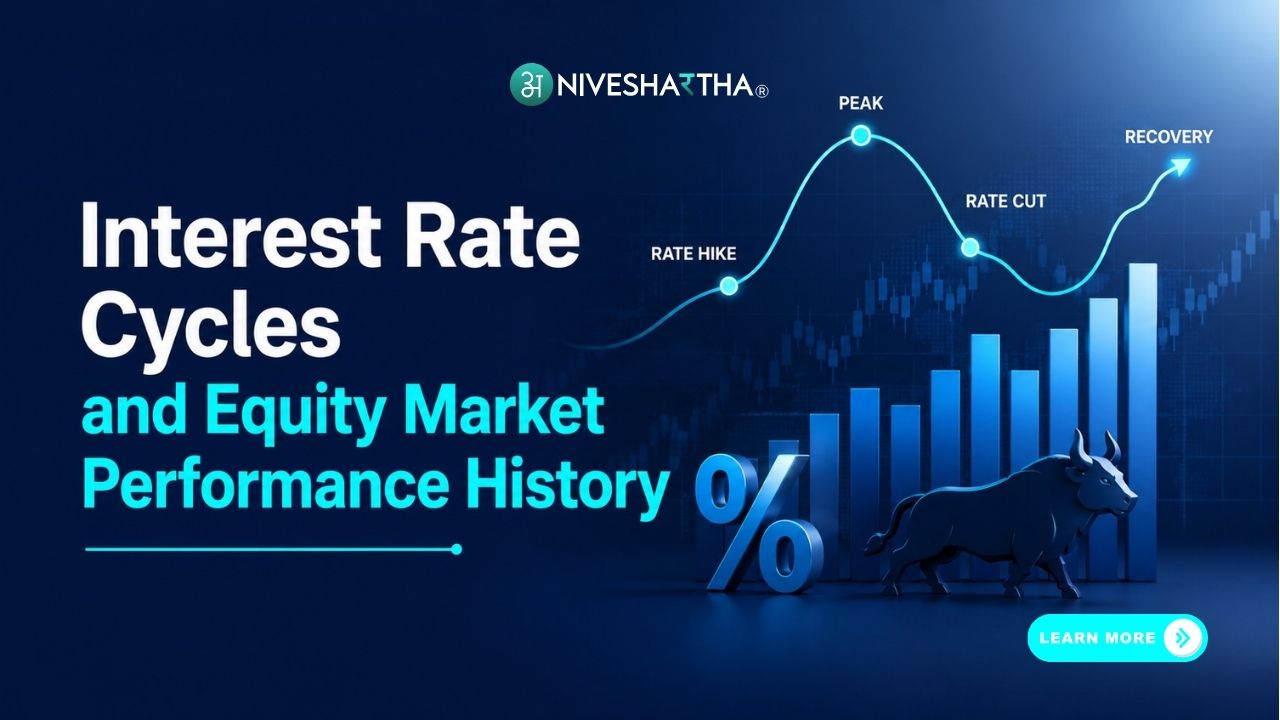
Interest rate cycles refer to periods during which central banks either increase, decrease, or maintain benchmark interest rates based on economic conditions.
Rate Hike Cycle
Central banks increase interest rates to manage inflation and moderate economic activity.
Characteristics:
- Higher borrowing costs.
- Reduced consumer spending.
- Increased savings rates.
- Moderation in economic growth.
Rate Cut Cycle
Central banks lower interest rates to stimulate economic activity.
Characteristics:
- Lower borrowing costs.
- Increased business investment.
- Improved consumer spending.
- Support for economic expansion.
Why Do Interest Rates Matter for Equity Markets?
Interest rates affect various aspects of the economy and financial markets.
- Corporate Borrowing – Lower interest rates may reduce financing costs for businesses, while higher rates can increase borrowing expenses.
- Consumer Spending – Interest rates influence home loans, vehicle loans, and other forms of credit, affecting overall consumption.
- Business Expansion – Companies often evaluate borrowing costs before investing in new projects and expansion plans.
- Investment Preferences – Interest rate changes may influence how investors allocate capital across different asset classes.
Historical Relationship Between Interest Rates and Equity Markets
During Rate Hike Cycles
Equity markets may experience periods of volatility as investors assess economic conditions and corporate earnings expectations.
However, markets have historically performed well during certain rate hike periods when economic growth remained strong.
During Rate Cut Cycles
Lower interest rates often improve liquidity and encourage economic activity, which can support business growth and market participation.
Nevertheless, the overall market environment depends on broader economic conditions.
Sector-Wise Impact of Interest Rate Cycles
Different industries may respond differently to changing interest rates.
- Banking and Financial Services
- Real Estate
- Automobile Industry
- Infrastructure
- Consumer Goods
Interest Rates and India's Equity Markets
India's financial markets are influenced by monetary policy decisions and broader economic developments.
Factors that investors often monitor include:
- Inflation trends.
- Economic growth.
- Monetary policy announcements.
- Global market conditions.
- Currency movements.
- Commodity prices.
Global Interest Rate Trends and Their Influence
Major global central banks can influence international financial markets.
Global interest rate movements may affect:
- Capital flows.
- Currency markets.
- Trade dynamics.
- Commodity prices.
- International investments.
India's economy and financial markets are interconnected with these global developments.
What History Teaches Us
- Economic Growth Matters
- Markets Adapt
- Sector Rotation Occurs
- Long-Term Perspective Is Important
Why This Matters for Market Participants
Understanding interest rate cycles helps individuals better interpret economic developments and market behaviour.
For those interested in Investing In Stocks and researching Best Long Term Stocks, studying macroeconomic factors such as monetary policy can provide useful context alongside company fundamentals, industry trends, and broader economic indicators.
Challenges in Predicting Market Reactions
Although historical patterns provide useful insights, market reactions depend on multiple factors.
- Inflation expectations.
- Economic growth.
- Corporate earnings.
- Global events.
- Government policies.
- Investor sentiment.
Conclusion
Interest rate cycles have historically influenced economic activity and equity markets by affecting borrowing costs, investment decisions, and consumer behaviour. While changes in interest rates can create periods of uncertainty or optimism, market performance ultimately depends on a combination of economic, corporate, and global factors.
For individuals interested in Investing In Stocks and understanding Best Long Term Stocks, analysing interest rate cycles alongside broader economic trends can provide valuable market context. At NiveshArtha, we believe that research-driven insights and a deeper understanding of macroeconomic developments help investors and market participants stay informed about the factors shaping financial markets.
Disclaimer
This article is intended for informational and educational purposes only and should not be construed as investment advice or a recommendation to buy, sell, or hold any security or financial product. Readers should conduct their own research and consult qualified financial professionals before making investment decisions.
NiveshArtha
June 2026
Get in touch with us
Start investing today, for a better tomorrow
If you’d like to talk to our executive kindly call us on +91 8884014014 during 9 am - 5 pm weekdays.
Start investing today, for a better tomorrow
If you’d like to talk to our executive kindly call us on +91 8884014014 during 9 am - 5 pm weekdays.





*Disclaimer: “Registration granted by SEBI, Enlistment as RA with Exchange and certification from NISM in no way guarantee performance of the intermediary or provide any assurance of returns to investors.”
*Disclaimer: For security/securities displayed in the website and in the advertisement - “The securities quoted (If any) on our website or in any of our advertisement are for illustration only and are not recommendatory.”
*Standard warning: “Investment in securities market are subject to market risks. Read all the related documents carefully before investing.”
*Mandatory notice: “Clients shall be requested to go through Do’s and Don’ts while dealing with RA as specified in SEBI master circular no. SEBI/HO/MIRSD-POD- 1/P/CIR/2024/49 dated May 21, 2024 or as may be specified by SEBI from time to time.”
Note: We have changed our pricing with effective from 01/12/2024.
Niveshartha ©2026 All Rights Reserved.
Developed by Techisor