
Introduction
When searching for Multibagger Stocks, many investors concentrate on company-specific factors such as revenue growth, profitability, and valuations. While these metrics are essential, understanding the overall health of the stock market is equally important.
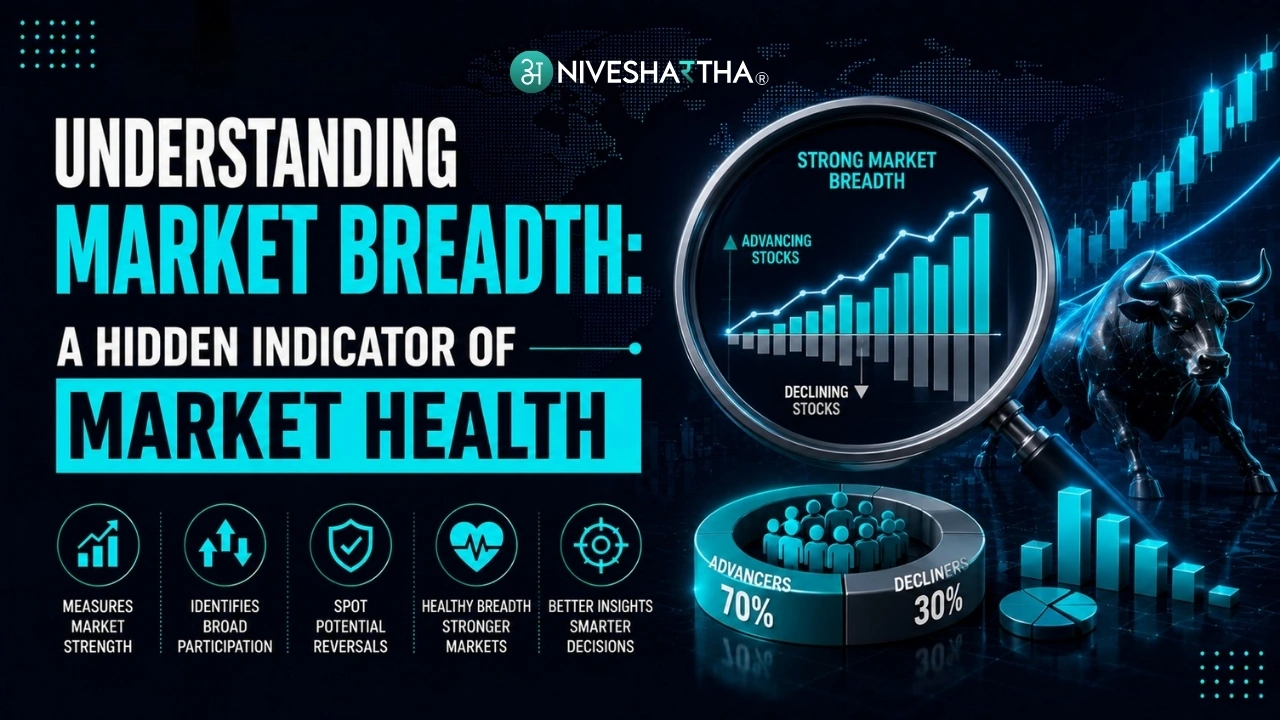
One powerful yet often overlooked indicator is market breadth. It measures how broadly stocks are participating in a market trend and helps investors determine whether a rally is supported by widespread buying or driven by only a handful of large companies.
By analyzing market breadth, investors can make more informed decisions and identify stronger market opportunities.
What Is Market Breadth?
Market breadth is a technical indicator that measures the overall participation of stocks in a market movement. Instead of focusing only on benchmark indices like the Nifty 50 or Sensex, market breadth looks at how many stocks are rising versus how many are falling.
A market rally supported by a large number of advancing stocks is generally considered healthier and more sustainable than one driven by only a few heavyweight companies.
Why Market Breadth Matters
Market indices are weighted based on the market capitalization of companies. This means a few large-cap stocks can significantly influence the movement of an index, even if the majority of stocks are declining.
For example, the Nifty 50 may post gains because a handful of large companies are performing well, while hundreds of mid-cap and small-cap stocks may be underperforming. Market breadth helps investors uncover the true strength of the broader market.
By monitoring market breadth, investors can better understand:
- Overall market strength
- Investor participation
- Market sentiment
- Trend sustainability
- Potential market reversals
Key Market Breadth Indicators
Advance-Decline Ratio
The Advance-Decline (A/D) Ratio compares the number of stocks that close higher with those that close lower during a trading session.
- More advancing stocks indicate strong buying interest.
- More declining stocks may suggest weakening market sentiment.
A consistently positive Advance-Decline Ratio often confirms the strength of an ongoing market trend.
Advance-Decline Line
The Advance-Decline Line is a cumulative measure of advancing and declining stocks over time.
If the market index is reaching new highs while the Advance-Decline Line is weakening, it may indicate that fewer stocks are supporting the rally. Such divergence can sometimes signal a weakening trend.
New Highs vs. New Lows
Another useful breadth indicator compares:
- Stocks making new 52-week highs
- Stocks making new 52-week lows
A healthy market generally sees a larger number of stocks reaching new highs, reflecting broad-based strength.
Sector Participation
Strong market rallies usually involve participation from multiple sectors, including:
- Banking
- Information Technology
- Pharmaceuticals
- Automobile
- FMCG
- Capital Goods
If only one or two sectors are leading the market while others remain weak, the rally may not be as sustainable.
What Strong Market Breadth Indicates
Healthy market breadth often reflects:
- Broad investor confidence
- Strong institutional participation
- Sustainable market momentum
- Lower concentration risk
- Positive market sentiment
When most stocks move higher together, it suggests that market strength extends beyond a few large companies.
What Weak Market Breadth Indicates
Weak market breadth may signal:
- Narrow market participation
- Growing uncertainty
- Increased market risk
- Sector-specific weakness
- Potential market correction
Even if benchmark indices continue rising, weakening breadth can indicate that the broader market is losing momentum.
How Market Breadth Helps Investors
Market breadth provides valuable context that price indices alone cannot offer.
Investors can use market breadth to:
- Confirm the strength of market trends
- Avoid being misled by index movements
- Identify healthier market environments
- Understand overall investor sentiment
- Improve portfolio allocation decisions
While market breadth should not be used in isolation, it serves as an effective supporting indicator alongside fundamental analysis.
Common Mistakes Investors Make
Many investors pay attention only to headline index movements and overlook broader market participation.
Some common mistakes include:
- Assuming a rising index always indicates a strong market
- Ignoring declining participation among stocks
- Overlooking sector performance
- Making emotional investment decisions during short-term market swings
Monitoring market breadth helps investors develop a more balanced perspective.
Combining Market Breadth with Fundamental Analysis
Market breadth becomes even more valuable when combined with other investment factors such as:
- Revenue and earnings growth
- Return on Equity (ROE)
- Cash Flow
- Debt levels
- Valuation metrics
- Corporate governance
- Industry outlook
Using both technical and fundamental insights allows investors to make more informed decisions.
Why Long-Term Investors Should Track Market Breadth
Long-term investing is not just about selecting good companies—it also involves understanding the market environment in which those businesses operate.
Healthy market breadth often reflects stronger investor confidence and better market participation, creating favorable conditions for quality companies to perform well over time.
By tracking market breadth consistently, investors can gain a broader perspective on market trends without reacting to short-term volatility.
Conclusion
Finding Multibagger Stocks requires more than analyzing individual company fundamentals—it also requires understanding the overall health of the market.
Market breadth is a powerful indicator that reveals whether market movements are supported by broad participation or driven by only a few large companies. By combining market breadth analysis with strong fundamental research, investors can gain greater confidence in evaluating market trends and identifying quality businesses.
At NiveshArtha, we believe that successful investing is built on research, discipline, and a comprehensive understanding of market dynamics. Incorporating market breadth into your investment analysis can help you make more informed decisions and strengthen your long-term investment strategy.
Niveshartha
August 3, 2026
Get in touch with us
Start investing today, for a better tomorrow
If you’d like to talk to our executive kindly call us on +91 8884014014 during 9 am - 5 pm weekdays.
Start investing today, for a better tomorrow
If you’d like to talk to our executive kindly call us on +91 8884014014 during 9 am - 5 pm weekdays.





*Disclaimer: “Registration granted by SEBI, Enlistment as RA with Exchange and certification from NISM in no way guarantee performance of the intermediary or provide any assurance of returns to investors.”
*Disclaimer: For security/securities displayed in the website and in the advertisement - “The securities quoted (If any) on our website or in any of our advertisement are for illustration only and are not recommendatory.”
*Standard warning: “Investment in securities market are subject to market risks. Read all the related documents carefully before investing.”
*Mandatory notice: “Clients shall be requested to go through Do’s and Don’ts while dealing with RA as specified in SEBI master circular no. SEBI/HO/MIRSD-POD- 1/P/CIR/2024/49 dated May 21, 2024 or as may be specified by SEBI from time to time.”
Note: We have changed our pricing with effective from 01/12/2024.
Niveshartha ©2026 All Rights Reserved.
Developed by Techisor