
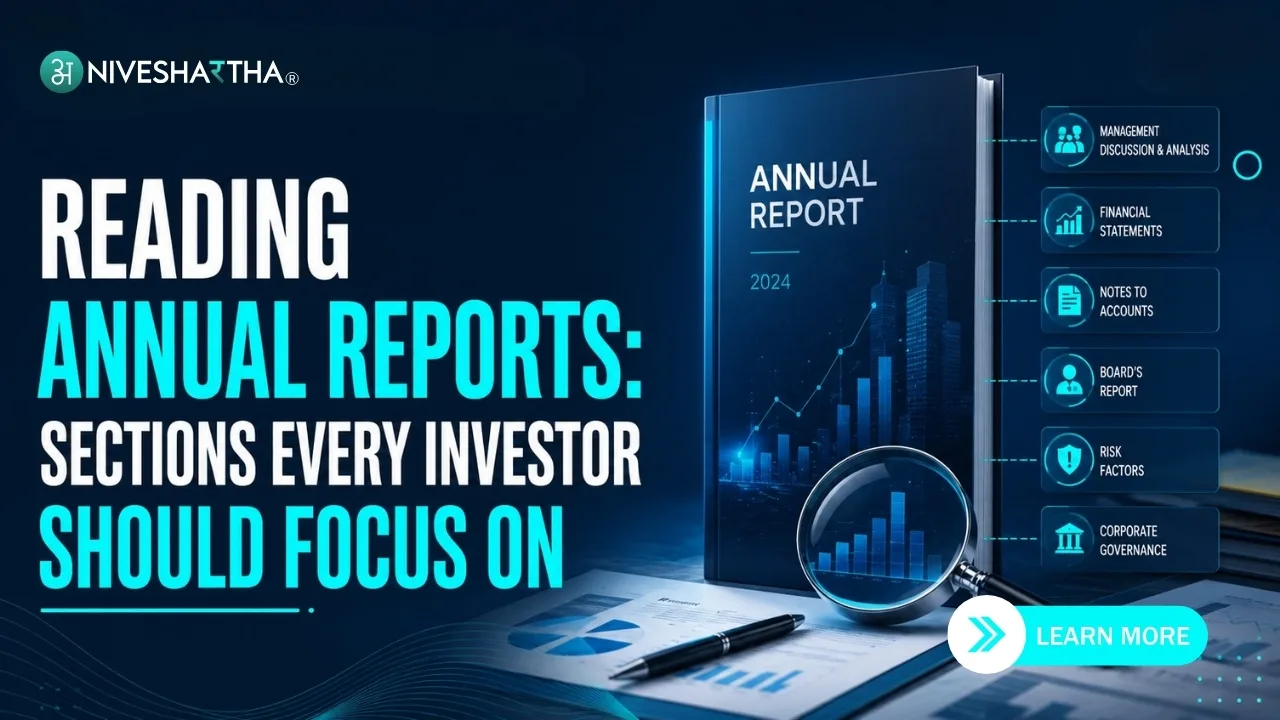
For anyone involved in Share Market Investment, an annual report can provide valuable insights into a company's financial performance, business strategy, risks, and future outlook. Instead of focusing only on the share price or headlines, investors can use annual reports to understand how a company actually operates and whether its fundamentals support its long-term prospects.
What Is an Annual Report?
An annual report is a comprehensive document published by a company to provide shareholders and other stakeholders with information about its business and financial performance during a financial year.
It typically includes financial statements, management commentary, business updates, risk disclosures, corporate governance information, and details about the company's operations.
For investors, the challenge is not finding information but knowing which sections deserve the most attention.
1. Management Discussion and Analysis
The Management Discussion and Analysis (MD&A) section is one of the most useful parts of an annual report.
It provides management's perspective on:
- Business performance
- Industry conditions
- Revenue and profitability trends
- Key opportunities
- Major challenges
- Future business priorities
- Changes in operating conditions
This section can help investors understand why financial numbers changed rather than simply looking at the numbers themselves.
However, investors should remember that management commentary represents the company's perspective and should be compared with the actual financial statements.
2. Profit & Loss Statement
The Profit & Loss Statement shows how much revenue a company generated and how much profit it earned during the financial year.
Important figures to examine include:
- Revenue
- Operating profit
- EBITDA
- Profit before tax
- Net profit
- Earnings per share
Rather than looking at one year's profit alone, investors can compare several years to identify whether the company's earnings are growing consistently.
For investors researching Best Long Term Stocks, consistent revenue and profit growth can be an important part of fundamental analysis.
3. Balance Sheet
The balance sheet provides a snapshot of a company's financial position.
Assets
These include cash, investments, inventory, property, equipment, and other resources owned by the company.
Liabilities
These include borrowings, trade payables, and other obligations.
Shareholders' Equity
This represents the shareholders' interest in the company after accounting for its liabilities.
A strong balance sheet can provide greater financial flexibility, while excessive debt may increase financial risk.
4. Cash Flow Statement
Profit does not always mean that a company is generating sufficient cash.
The Cash Flow Statement helps investors understand how cash moves through the business.
It generally consists of:
- Cash flow from operating activities
- Cash flow from investing activities
- Cash flow from financing activities
One important area to examine is cash flow from operations.
If a company consistently reports accounting profits but generates weak operating cash flow, investors may want to investigate why.
5. Notes to Financial Statements
The notes accompanying the financial statements are often overlooked, but they can contain some of the most important details.
They may explain:
- Accounting policies
- Debt obligations
- Contingent liabilities
- Related-party transactions
- Revenue recognition
- Investments
- Segment information
- Tax-related matters
Reading these notes can provide context that may not be immediately visible in the main financial statements.
6. Auditor's Report
The auditor's report provides an independent assessment of the company's financial statements.
Investors should pay attention to whether the auditor has issued:
- An unmodified opinion
- A qualified opinion
- An adverse opinion
- A disclaimer of opinion
Investors should also look for Key Audit Matters (KAMs), which highlight areas that required significant auditor attention.
These sections can point investors toward areas that deserve closer examination.
7. Risk Factors
Every business faces risks, and annual reports generally provide information about the major risks affecting the company.
These may include:
- Competition
- Regulatory changes
- Commodity prices
- Currency movements
- Interest rates
- Supply-chain disruptions
- Customer concentration
- Technological changes
Understanding these risks helps investors evaluate whether the company's growth prospects are sustainable.
8. Corporate Governance
Corporate governance provides information about how the company is managed and overseen.
Investors can examine:
- Board composition
- Independent directors
- Management remuneration
- Related-party transactions
- Committee structures
- Shareholding patterns
Good corporate governance can contribute to greater transparency and accountability.
9. Promoter and Shareholding Information
Shareholding information can help investors understand who controls the company and how ownership is distributed.
Important areas include:
- Promoter holding
- Changes in promoter ownership
- Institutional ownership
- Pledged shares
- Public shareholding
Significant changes in ownership can sometimes provide useful context when analysing a company.
10. Business Segment Information
Large companies may operate across multiple businesses or geographical markets.
Segment information can help investors understand:
- Which business generates the most revenue
- Which segment contributes the most profit
- Which segments are growing faster
- Which businesses may be facing pressure
This can prevent investors from evaluating a diversified company based only on its consolidated numbers.
11. Capital Allocation
Another important area is how management uses the company's available capital.
Investors can examine whether cash is being allocated toward:
- Business expansion
- Debt reduction
- Acquisitions
- Dividends
- Share buybacks
- Research and development
- New projects
Effective capital allocation can play an important role in long-term shareholder value.
A Simple Way to Read an Annual Report
You don't necessarily have to read every page from beginning to end.
A practical approach is:
Step 1: Understand the company's business model.
Step 2: Read the management discussion and industry overview.
Step 3: Review revenue and profit trends.
Step 4: Examine the balance sheet and debt position.
Step 5: Check operating cash flows.
Step 6: Review the auditor's report and important notes.
Step 7: Examine risks and contingent liabilities.
Step 8: Look at promoter and institutional shareholding.
Step 9: Understand segment performance.
Step 10: Evaluate management's capital-allocation decisions.
This approach can help investors focus on information that may have a meaningful impact on their investment analysis.
Don't Look at Numbers in Isolation
A single financial ratio or one year's growth rate rarely tells the complete story.
For example, rising revenue may look positive, but investors should also ask:
- Is profit growing at the same pace?
- Is operating cash flow improving?
- Is debt increasing?
- Are margins sustainable?
- Is the company generating adequate returns on capital?
- Are future investments likely to generate attractive returns?
Combining financial numbers with qualitative information can provide a more complete understanding of a business.
Final Takeaway
An annual report is more than a collection of financial statements. It can help investors understand a company's business model, financial health, risks, management strategy, governance, and capital allocation.
For investors exploring Share Market Investment and Investing In Stocks, learning to read annual reports can strengthen the process of evaluating companies and identifying potential Best Long Term Stocks.
NiveshArtha provides research-based market insights to help investors better understand companies, financial information, and important developments in the stock market.
Niveshartha
August 25, 2026
Get in touch with us
Recent Posts
Start investing today, for a better tomorrow
If you’d like to talk to our executive kindly call us on +91 8884014014 during 9 am - 5 pm weekdays.
Start investing today, for a better tomorrow
If you’d like to talk to our executive kindly call us on +91 8884014014 during 9 am - 5 pm weekdays.





*Disclaimer: “Registration granted by SEBI, Enlistment as RA with Exchange and certification from NISM in no way guarantee performance of the intermediary or provide any assurance of returns to investors.”
*Disclaimer: For security/securities displayed in the website and in the advertisement - “The securities quoted (If any) on our website or in any of our advertisement are for illustration only and are not recommendatory.”
*Standard warning: “Investment in securities market are subject to market risks. Read all the related documents carefully before investing.”
*Mandatory notice: “Clients shall be requested to go through Do’s and Don’ts while dealing with RA as specified in SEBI master circular no. SEBI/HO/MIRSD-POD- 1/P/CIR/2024/49 dated May 21, 2024 or as may be specified by SEBI from time to time.”
Note: We have changed our pricing with effective from 01/12/2024.
Niveshartha ©2026 All Rights Reserved.
Developed by Techisor