
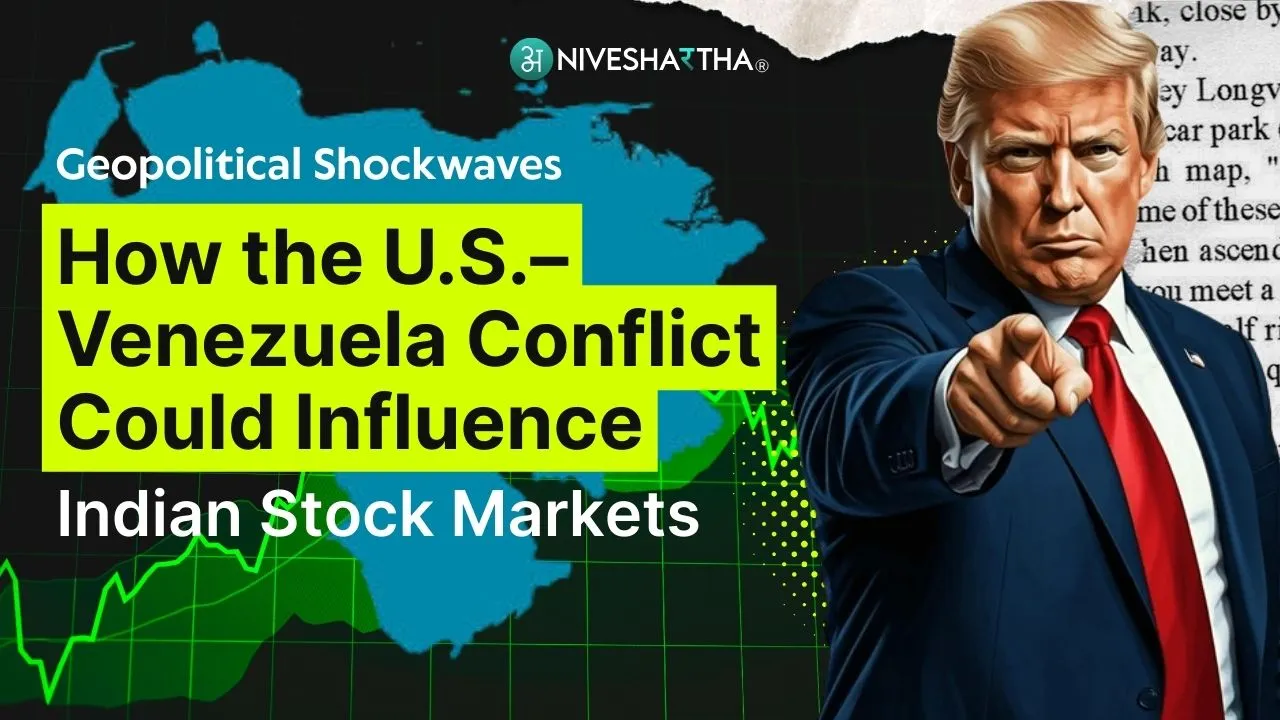
Global financial markets are increasingly sensitive to geopolitical developments, and the recent U.S.–Venezuela conflict is a clear example of how political actions can trigger economic ripple effects worldwide. While India does not have deep direct trade ties with Venezuela, the indirect impact through crude oil prices, global market volatility, inflation, and foreign investor sentiment could significantly influence the Indian stock market.
This blog provides a detailed Indian stock market analysis of how this geopolitical crisis may affect various sectors, macroeconomic indicators, and investor strategies.
Understanding the U.S.–Venezuela Conflict and Global Market Sentiment
The U.S. military intervention in Venezuela has heightened global uncertainty, especially due to Venezuela’s strategic importance in the global oil and energy market . Even limited disruptions in politically sensitive regions often increase risk premiums in commodities and equities.
Global investors typically react to such geopolitical tensions by shifting capital toward safe-haven assets, reducing exposure to emerging markets, and increasing volatility across stock indices. For India, this translates into short-term pressure on equities driven more by sentiment than fundamentals.
Crude Oil Prices: The Biggest Risk Factor for India
The most critical channel through which the U.S.–Venezuela conflict could affect the Indian economy is crude oil price volatility.
India imports over 85% of its crude oil requirement, making it highly vulnerable to any global oil supply concerns. Even if Venezuelan oil supply disruption is limited, geopolitical risk often pushes Brent crude prices higher due to uncertainty.
Key impacts of rising crude oil prices:
- Higher import bill, widening the current account deficit
- Increased inflationary pressure, especially fuel and transportation costs
- Potential RBI policy tightening, impacting interest-rate-sensitive stocks
- Weakening of the Indian rupee
Sectors such as aviation, logistics, FMCG, paints, and chemicals could face margin pressure if oil prices remain elevated.
Sectoral Impact on the Indian Stock Market
Defence Stocks: Potential Beneficiaries
Geopolitical instability often boosts defense spending worldwide. Indian defence stocks may see increased investor interest due to rising global security concerns and India’s growing defense manufacturing capabilities.
Oil & Gas Stocks: High Volatility
Oil exploration companies and refiners may experience sharp price movements. While higher crude prices can benefit upstream companies, oil marketing companies may face margin pressure if fuel prices are regulated.
IT and Export-Oriented Stocks
A weaker rupee—triggered by foreign capital outflows—can benefit export-heavy sectors like IT and pharmaceuticals, improving dollar-denominated earnings.
Banking and Financial Stocks
Banks may experience short-term pressure if inflation concerns lead to tighter monetary policy. Higher interest rates can impact credit growth and valuations.
Impact on Inflation, RBI Policy, and Currency Markets
Sustained geopolitical risk can push oil prices higher, which feeds directly into retail inflation. If inflation exceeds comfort levels, the Reserve Bank of India may adopt a more cautious stance on interest rates.
Higher inflation and risk-off sentiment can also lead to:
- FII outflows from Indian equities
- Increased volatility in bond yields
- Pressure on the Indian rupee against the US dollar
These macroeconomic factors can influence overall stock market direction, especially in the short term.
Short-Term Volatility vs Long-Term Market Fundamentals
It’s important to note that while geopolitical conflicts can cause short-term market volatility, India’s long-term growth story remains intact. Strong domestic consumption, infrastructure spending, manufacturing growth, and digital expansion continue to support economic fundamentals.
Historically, Indian stock markets have shown resilience, often recovering once geopolitical uncertainty stabilizes.
Investment Strategy During Geopolitical Uncertainty
For investors, the key is not panic but preparation:
- Avoid emotional trading based on headlines
- Maintain portfolio diversification across sectors
- Monitor crude oil trends and RBI policy signals
- Use volatility to accumulate quality stocks at better valuations
- Focus on fundamentally strong companies with pricing power
Geopolitical events often create opportunities for disciplined, long-term investors.
Conclusion: How Indian Investors Should Navigate Global Geopolitical Risks
In conclusion, the U.S.–Venezuela conflict highlights how global geopolitical events can influence the Indian stock market through oil prices, inflation, currency movement, and investor sentiment. While the immediate impact may be driven by volatility and risk aversion, long-term investors should focus on fundamentals rather than fear.
Platforms like Niveshartha help investors navigate such complex global developments by offering in-depth market research, macroeconomic insights, and sector analysis. With Niveshartha's expert guidance, investors can make informed decisions, manage risk effectively, and uncover opportunities even during periods of geopolitical uncertainty.
Niveshartha
Jan 09, 2026
Get in touch with us
Start investing today, for a better tomorrow
If you’d like to talk to our executive kindly call us on +91 8884014014 during 9 am - 5 pm weekdays.
Start investing today, for a better tomorrow
If you’d like to talk to our executive kindly call us on +91 8884014014 during 9 am - 5 pm weekdays.





*Disclaimer: “Registration granted by SEBI, Enlistment as RA with Exchange and certification from NISM in no way guarantee performance of the intermediary or provide any assurance of returns to investors.”
*Disclaimer: For security/securities displayed in the website and in the advertisement - “The securities quoted (If any) on our website or in any of our advertisement are for illustration only and are not recommendatory.”
*Standard warning: “Investment in securities market are subject to market risks. Read all the related documents carefully before investing.”
*Mandatory notice: “Clients shall be requested to go through Do’s and Don’ts while dealing with RA as specified in SEBI master circular no. SEBI/HO/MIRSD-POD- 1/P/CIR/2024/49 dated May 21, 2024 or as may be specified by SEBI from time to time.”
Note: We have changed our pricing with effective from 01/12/2024.
Niveshartha ©2026 All Rights Reserved.
Developed by Techisor